"Select stocks, buy and sell repeatedly, maximize returns." The sentence sounds natural. What happens when you turn it into a testable experiment?
I preregistered three rules over a universe of 50 US megacaps. All three are decades-old literature shapes, none tuned on this data: 12-1 cross-sectional momentum top 5 (rebalanced every 21 sessions), 20-day momentum top 5 (every 5), 5-day reversal bottom 5 (every 5). Signals at the close, fills at the next open, 20bp per side, whole shares only. Because my previous experiment's comparator couldn't afford a single share, any symbol too expensive for one share per slot is skipped in the ranking.
Two benchmarks: SPY buy-and-hold, and an equal-weight buy-and-hold of the same universe. The screen ran exactly once, after the code was frozen.
Which of the three would you have bet on passing?
Screen results
2022-06 through 2026-09, ~1,066 sessions:
| Return (KRW) | Fills | 2x costs | t (vs equal weight) | |
|---|---|---|---|---|
| Equal-weight hold | +149.2% | 0 | — | — |
| 12-1 momentum | +116.4% | 95 | +118.7% | +0.04 |
| 20-day momentum | +111.7% | 955 | +52.9% | -0.21 |
| SPY hold | +98.9% | 1 | — | — |
| 5-day reversal | +23.0% | 1,865 | -39.9% | -1.93 |
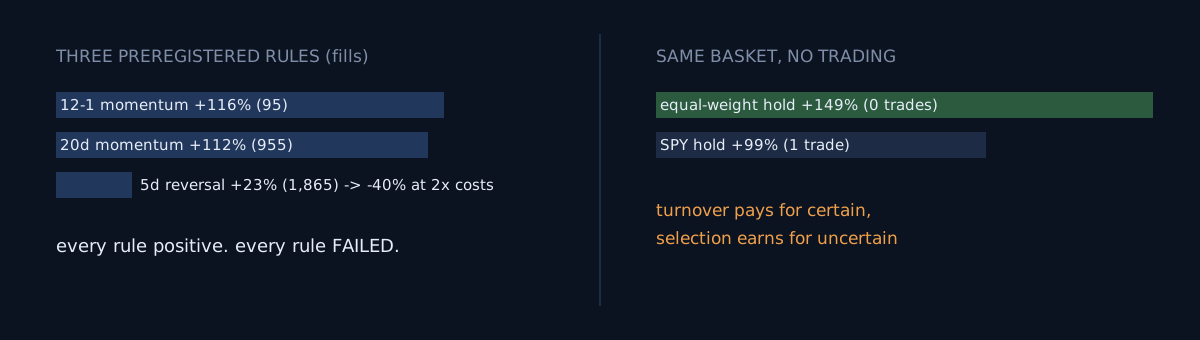
All three FAILED on beats_equal_weight. Every absolute return is positive, which looks respectable — and every one of them did worse than buying those same stocks and leaving them alone for four years.
The table also shows turnover eating itself. The 5-day reversal filled 1,865 times; doubling costs flipped its +23% to -40%. The 20-day momentum's 955 fills lose half their profit at 2x costs. Each trade exchanges a certain payment (costs) for an uncertain gain (selection edge) — and the edge side never showed up.
The fourth confirmation
For me this is the fourth independent observation of the same conclusion. A time-series foundation model couldn't beat a random walk; an ETF momentum comparator's edge was one ticker; a family of timing strategies lost to a constant leverage number; and now three cross-sectional selection rules lost to the basket.
As a sentence: at this cost scale (20bp per side) and this capital scale (a few thousand dollars), repeated buying and selling is not a mechanism for maximizing returns — it's a drain on them. The repetition itself pays costs, and no experiment produced selection skill that covered them.
The pipeline survives
The preregistration said: if everything fails the screen, forward tracking never starts. I followed it. Running a losing rule anyway "to observe the failure" becomes a zombie track wearing a research badge.
The pipeline itself remains: preregistered screen, then forward paper (plans generated before the session, settled at the next open, futility early-kill), then live trading behind a double lock — gate pass AND explicit human approval. If a rule ever passes the screen, only the scheduler is missing. I didn't attach a scheduler to a closed experiment; that's just noise.
Self-check, 3 items
- Is your turnover strategy benchmarked against an equal-weight hold of its own universe? Beating SPY alone may be credit that belongs to your universe choice.
- Does the sign survive doubled costs? If turnover × cost exceeds the observed edge, the answer already exists.
- Is "what happens if everything fails" written down before the results existed?
The honest part
The most valuable output of this experiment isn't the return table — it's the refusal. The gate failed everything and thereby kept a losing strategy out of forward tracking and out of a real account. A gate's purpose isn't to pass things. It's to block them.
Compute exactly one number today: your strategy's annual round trips × round-trip cost. If that exceeds its backtested annual return, your strategy's opponent isn't the market. It's the fee schedule.