The last big number you put in a report — big compared to what?
I skipped that question and shipped "516,000 characters unused." Plan a day around that number and the whole day points the wrong way.
What I measured first
The largest field in an Android store listing is the full description. The limit is 4,000 characters. Across 14 apps and 196 slots, only 34% was used.
unused = 4000 - len(body)
total  = 516,000 chars
So I wrote it down as "the biggest acquisition surface."
That number was measured against the wrong thing
4,000 is a ceiling, not a target.
If a good description is 2,000 characters, the other 2,000 are not "empty" — they're "not written." And search doesn't reward length, it reads content. Padding words to fill space actively costs you.
The real price of this misread isn't that a number was wrong. It's that the only conclusion that number supports is "fill everything." It generates a work plan to expand 196 slots, and that plan is wrong.
Measuring it again with a different yardstick
The question I should have asked: "has this locale lost content relative to the English source?"
Compare the translation to the source as a ratio, adjusted for per-language density.
| Language | Expected density vs English |
|---|---|
| Chinese | 0.45 |
| Japanese | 0.55 |
| Korean | 0.60 |
| Thai | 0.80 |
expected = len(english_body) * DENSITY[lang]
shortfall = max(0, expected - len(body))
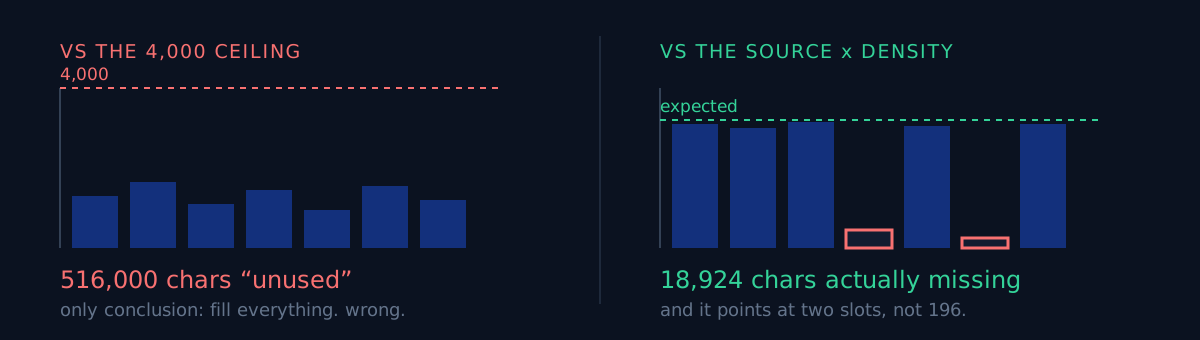
That gives a shortfall of 18,924 characters. Not 516,000. Nineteen thousand. One twenty-seventh.
More importantly, most of it was concentrated in a few slots. One app alone accounted for 6,793 characters.
The real defects were three
Finding genuinely empty slots is a separate test: strip links and legal boilerplate, and if under 300 characters remain, there is no body.
- One app's Spanish description had no body at all. Two legal links, 102 characters, that's it.
- The French one was a 455-character fragment that also claimed integration with a feature from another platform that this app does not have — the same family as the paywall selling a feature that wasn't there.
- 24 slots still had the English title.
Three. Not 196. An aggregate cannot show you where to fix anything.
Which number would you report?
Both are true. 516,000 against the ceiling is correct; 19,000 against the source is correct. The difference is which action each one demands.
- 516,000 → "expand all 196 slots"
- 19,000 → "these two slots have no body"
The question when choosing a metric is not "is this number accurate," it's "is the action this number demands the right one."
The same week I hit a case where the surface really was empty — a validator was truncating at one third of the real limit, so emptiness was a genuine defect. The contrast is the point of this post: two datasets that both read "one third full" invert their conclusions depending on whether the ceiling is artificial or natural.
Three-line self-check
- Is your metric measured against a ceiling or against a baseline? Ceiling-relative metrics almost always demand "fill it up."
- Is the number concentrated or spread? Without the distribution, an aggregate can't point at anything.
- When you put a number in a report, did you write the unit and the yardstick next to it? If not, the reader plans a day around it.
The honest part
I shipped this misread in a report. Someone could have planned a day's work on it. When you quote a number without its unit and yardstick, a wrong number becomes a wrong plan verbatim. That damage is mine.
The density coefficients (0.45–0.80) are values I chose, and my only evidence is observation. They are not a measurement of information density; they're a line saying "close enough to call it the same content." If the coefficients are wrong, the shortfall is wrong with them. Which means 19,000 is not a settled number either.
And a good share of the remaining 14,332 characters is probably still legitimate compressed translation. Confirming that needs a clause-level comparison, and I didn't go that far.
If your dashboard has an "unused X" metric, open it and check what X is divided by. If the denominator is a ceiling, that metric is permanently red.