Do the languages your app supports match the languages your store page actually speaks? In every field?
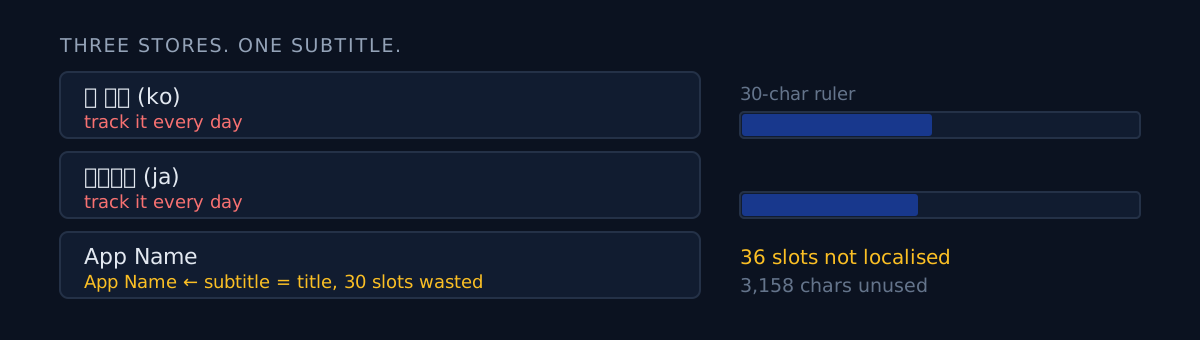
I only checked the big ones. So for months I didn't know that the 30-character subtitle under the app name was still the English original in 36 slots.
One field left
After auditing keywords and descriptions, one indexed field remained: the subtitle under the name. Limit: 30 characters.
It goes into the search index too. But it's short, so nobody had ever counted it. Thirty-character fields don't make it onto audit lists — you start with the big ones.
36 slots were English
Korean, Japanese, Arabic and Hindi stores, all with an English subtitle. The app itself was fully translated into those languages.
The loss is double.
- Users in that market read an English sentence directly under the app name.
- Not one search term in that language enters the index.
The second one is bigger. The first is "slightly off." The second is "one discovery path in that market does not exist."
Non-Latin locales also had a lot of unused surface. They averaged about half of the 30 characters, leaving 3,158 characters empty in total.
And one app used its own name as the subtitle in four locales. The name is already right above it. That's 30 characters thrown away.
The test is one line
for locale in locales:
    if locale != "en-US" and subtitle[locale] == subtitle["en-US"]:
        not_localised.append(locale)
If the string equals the English locale's subtitle, it isn't localised. There are almost no false positives — a subtitle is free-form prose, so two languages don't collide by accident.
Then measure the shortfall next to it:
remaining = 30 - len(subtitle)That's the keyword lesson repeating. A check that only blocks overflow never sees the shortfall.
Which app would you fix first?
One thing worth knowing. The subtitle lives somewhere different from keywords. It attaches to app-level info, not to a version. So an app sitting in review can be edited, and an app on sale needs a new version.
Which means the ordering is: the apps currently in review first. Everything else has to ride the next release. Walk in with "let's fix all 36" and you stall halfway.
Three-line self-check
- Does your listing audit include the short fields? A 30-character field is invisible and still indexed.
- Do you test for "equals the English value"? Detecting untranslated copy needs no translation-quality judgment. One string comparison does it.
- Did you check where the field lives before planning the fix? Version-scoped and app-scoped fields have different editable windows.
The honest part
What I actually fixed was five slots on one app that happened to be in review. The other 31 need a new version and were deferred to the next release. "Audited" and "fixed" are different words. This post covers the first one.
Fitting meaning plus a search term into 30 characters of another language is not a machine job. Word lengths differ, so a structure that's natural in English doubles in German. The five slots I fixed came out at 19–27 characters. I did not force them to 30 — shorter beats truncated.
And the exact weight the subtitle carries in search is not published anywhere. "It is indexed" is the part I know; anything past that is inference. The claim I can defend here is only that zero search terms in that language were present.
If you ship a multilingual app, open one subtitle field in your store console. If it's English, that market can only find you by name.