Following the conclusion of the previous post, where one checkbox blocked a personal account, I switched the developer account from personal to organization.
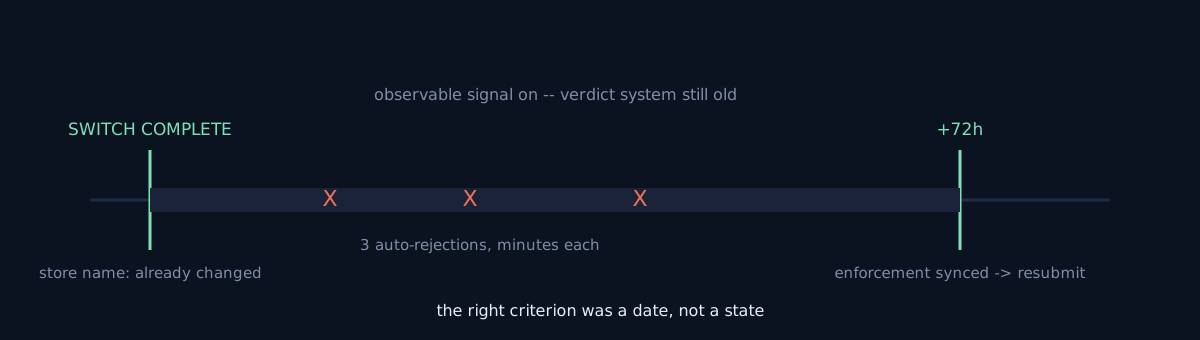
The document verification cleared, Account type became Organization, and I watched the store's developer info change to the company name. So I resubmitted the rejected apps.
Within minutes, rejected again for the same reason. The next day I tried once more with a different app. Rejected again.
In your systems, are you sure the screen where you can see a change and the system that actually renders the verdict are looking at the same thing?
I believed I'd found the "propagation complete" signal, and that belief produced three rejections
Right after the switch, I decided — correctly — not to resubmit immediately. Instead I picked a signal for myself: when the store's developer info changes to the company name, submit one app and see what happens.
It sounded reasonable. And the signal did light up. So I submitted, and it was rejected.
A support ticket reply supplied the missing piece. Three things got confirmed:
- The in-place switch is sufficient. You don't need to transfer apps to a separate account.
- The verification state takes up to 72 hours to sync into the enforcement system.
- After that window closes, bump the versionCode and resubmit.
So the store display and enforcement run separately. The front reads account info and renders it on the spot. The back looks at state synced into its own system. The thing I took as my signal was the front.
Here's the reversal
When there's only one observable signal, there's no guarantee that signal tells you the thing you actually want to know.
I treated "what's observable" and "what's used for the verdict" as the same thing. The screen changed, so the system must have changed too — that inference had no basis. The two values update over different paths, and one lighting up does not mean the other did.
The correct criterion was not a state but a date — switch-complete date + 72 hours. A criterion that's unobservable but certain beats one that's observable but wrong.
What would you do here?
Resubmission is a few button clicks, because a rejection preserves the unsubmitted changes intact. You made a plan to "carefully submit just one app" — do you hold to it through the second and third after the first rejection? Or do you press it once more thinking "maybe this time is different"?
The cheaper an action is to retry, the more you repeat it without justification. I pressed it three times.
Code, commands, numbers
- Resubmission timeline: 2 rejected on the switch-complete day → 1 rejected the next day → ticket reply received → resumed at switch-complete + 3 days.
- The rejections were automated verdicts within minutes, not human review. That reinforces the illusion that "I can just try again quickly."
- The instruction to bump the versionCode before resubmitting matters. Re-uploading the same versionCode is blocked with a 403
already been used. - Where to check: app → Publishing overview, and Submission activity. Rejections land in Submission activity with a timestamp.
- 72 hours is a maximum. It may open sooner, but there's no way to confirm that, so waiting is cheaper. I don't actually know when it opened — I uploaded nothing until the window had closed.
Three self-checks
- When you judge that some state has "taken effect," is your basis the value actually used for the verdict, or a display that updates next to it?
- If there's only one observable signal, what's your criterion when that signal is absent? Do you have something unobservable but certain, like "a date plus a fixed wait"?
- Is there an action whose retry cost is near zero? If so, does that action have an explicit gate to stop you repeating it without justification?
The honest part
Three resubmissions, all auto-rejected. All I got was a policy record. The caution of "submit just one app" didn't survive the second and third. I judged correctly that I should avoid resubmitting right after the switch — and then invented a verdict signal that neutralized that judgment. A baseless signal is an excuse not to wait.
The ticket reply's first AI answer named the cause and it matched my observations, but I didn't take it at face value — I confirmed with a human reply. Even so, this is a support channel's explanation, not a documented spec.
The earlier case in this family is completed 100% is not published — the same story, that a status display doesn't speak for the reality, in a different edition.
Do one thing now: recall a recent moment when you judged something had "taken effect" and moved on to the next step, and check whether your basis was the value used for the verdict or a display of it.