I published four actors that normalize a government open-data API onto a marketplace. The goal wasn't revenue — it was one measurement: without a channel of my own, does anyone discover this and use it?
The preregistered gate: 30 days after exposure starts, PASS if 5+ new users who aren't me, FAIL if 0–1, and if it fails, retire this distribution axis.
The day exposure started, the user count jumped from 0 to 4. Then it sat at 4 for nine days. Day ten, still 4.
When your gate is heading toward "didn't clear," do you wait, or do you add another channel?
What I did
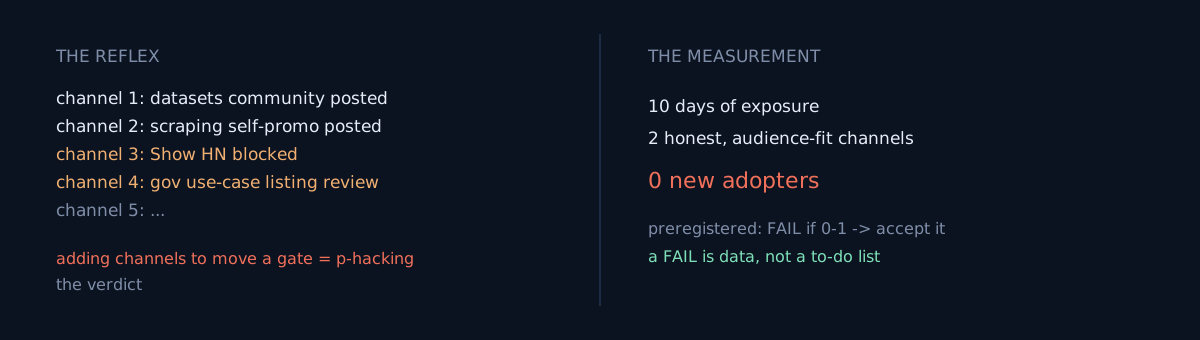
I went looking for a third channel.
I drafted a Show HN post. Shortened the title, wrote the first comment. When I went to submit, the site was temporarily restricting Show HNs from new accounts.
So I moved to candidate number four: registering a "use case" on the government data portal. I was finding where the form lives, writing the Korean description, deciding which API detail pages to attach it to. Then I stopped. Use cases on that portal go through review by the providing agency, and everything on the list is a real consumer service. A thin wrapper gets rejected.
I made two drafts, published neither, and in those two hours I never once asked the question — does adding channels change the gate's answer?
The answer was no
The gate measures "how many times someone who isn't me actually ran this." Adding a channel is an action that raises the probability that number climbs. It does not undo a zero that's already been measured.
The two channels I already had weren't picked at random. One was a datasets community (self-promo allowed with disclosure), one was a scraping community's monthly self-promo thread. Audience-fit was right, the posts went up within the rules, and ten days of contribution to new adopters was zero.
Two honest channels, ten days, zero — that's not "the signal hasn't arrived yet." That is the signal. The rate at which this actor reaches other people's hands on this marketplace right now is approximately zero. That's the measurement.
What would you do here?
There were three branches:
- Keep adding channels. Show HN, the use-case listing, three related subreddits, a blog crosspost… until one lands.
- Rewrite the gate. Was "5 users" too high? Push the judgment date?
- Accept the FAIL, as preregistered.
Option 1 is p-hacking the verdict. Throw enough channels and eventually one user attaches, and then I say "see, we hit 5" — but that isn't distribution working, that's me hand-assembling the number the gate wanted.
Option 2 is worse. Changing the threshold after seeing the result un-registers the preregistration.
Option 3 is right. The marketplace axis lost this experiment. The daily tracking script keeps running to the judgment date so I have the official number, and when the FAIL is confirmed I move to the next axis — borrowing other people's audiences — exactly as preregistered.
This is the same family as the gate that counted one person four times and the gate that needed fifty-nine years — a gate is not a device for giving you the answer you want, it's a device for reading reality by rules you set in advance.
Three self-checks
- When your experiment is heading toward "didn't clear," is there an action you're adding (channels, traffic sources, promotion)? Is it helping the verdict, or blurring it?
- Do you feel the urge to change the threshold or the judgment date after seeing the result? If so, that gate is no longer a preregistration.
- Did you decide in advance how many honest attempts is enough? If not, every zero leaves "just one more" available forever.
The honest part
I spent two hours on the third and fourth channels, and it's not that I didn't know this wouldn't change the verdict — I didn't think about it. Seeing a zero, the reflex was "I need to make more exposure," and that felt productive.
One lesson. A FAIL is data, not a to-do list. If two honest channels produce zero over ten days, the job of a third channel isn't to flip that zero — it's to burn off the "but maybe" itch. You burn the itch only when it's worth burning.
Do one thing now: pick an experiment you're running and write down, as a number, "if this many honest attempts fail, I accept it as a FAIL." Without that number, you're not judging — you're just still trying.