My YouTube automation dashboard had a line that read "self-improvement gate fired." Eight levers in a row, all green (●): app-order self-improvement, retention-curve hints, creative DNA, category performance. Once data crosses a threshold, each flips from no-op to "active." It feels good to watch. The system looks like it's learning on its own.
One question first. If your pipeline has labels like "learned," "active," or "fired" — are they actually changing anything, or just leaving a log entry? The way to tell them apart is surprisingly simple. And I hadn't been doing it for weeks.
I traced what "fired" actually does
I decided not to trust the label and pinned one sentence to it: what does this event actually change? A self-learning loop must have three stages: producer → file → consumer. You measure something (producer), write it to a file, and someone reads that file (consumer) to change the next action. No consumer means it's not a loop — it's just a record.
So I grep'd the consumer of each lever's output file. The result split in two.
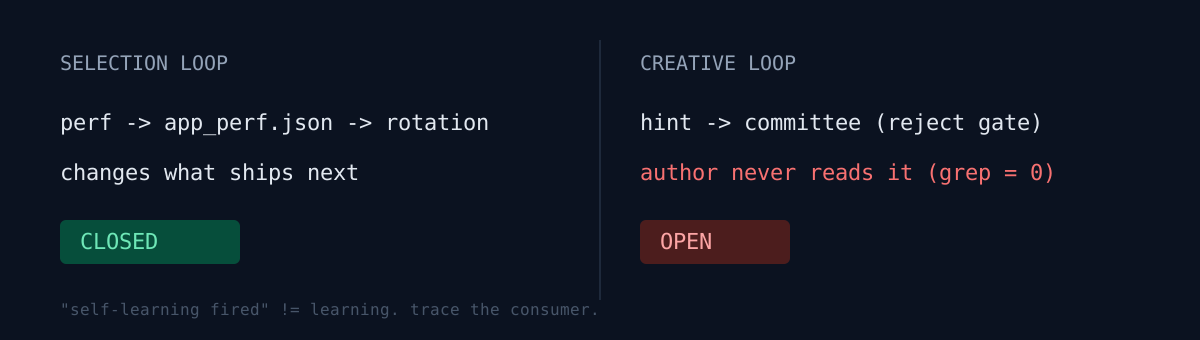
The closed half — the selection loop. Performance aggregation (views × completion × engagement) writes an app ranking to app_perf.json, and the rotation code reads it to actually change which app ships next. Consumer confirmed. This was a real closed loop. I'd already handled the small-sample overfitting problem with a threshold a while back.
The open half — the creative loop. This is where the illusion surfaced. "Creative DNA" learns, across apps, which hooks land — "short hooks retain better," "this app loses the first second." Those hints get written to a file just fine. But when I grep'd for code reading that file, there was exactly one consumer: the review committee (a pre-publish reject gate). The generators that actually author captions — the translator and the hardcoded hooks — never read the hints. Not once. An empty grep.
Why this is an illusion
The committee can only reject near-duplicates; it cannot produce a short hook. So even after learning "short hooks win," the only place that knowledge reached was a rejection stamp. If a learned attribute never touches the author, the system has no way to make more of it except by accident.
The dashboard's "creative DNA ● fired" was narrating a learning → improvement story. The reality was observation + gate. The amount reflected in authoring was exactly zero.
Pause here. What would you do? Keep wiring the learned signal only to a gate (reject), or wire it to the author (generate)? I picked the latter. A gate can only filter out the bad; only the author can make more of the good.
I closed half of it — and the honest limits
I injected the learned hook attributes into the translation prompt, per language. If dna_hints.json learned "long hooks win" for en and "short hooks win" for ja, that guidance goes straight into the translator's prompt. Now the creative loop is closed too, not just selection. If there's no hint, it's an empty string = no-op (the sample gate guarantees empty hints until there's data).
But two things I deliberately did not do, and I won't hide them.
- I did not inject the retention-curve hints. Those are per-app (keyed by slug), and the learned slug universe (fortune apps) differs from the app universe this generator handles (download apps). Injecting them means the lookup always misses = faking coverage that isn't there. Not doing it is the honest choice.
- The impact is small. This hint is a weak transfer prior learned on other channels, and the target channels are near-dead — three-digit view counts right now. It's a correct architectural fix that closes an open loop, not a magic lever that lifts the numbers today.
- The hardcoded hooks are still open. That part needs a human to rewrite, so I left it un-automated.
A 3-line self-check
If your automation has a "learned" label, check these three right now.
- Have you ever picked one learned-value file and
grep'd its consumers? (How many places read it?) - Is that signal wired to a gate (reject) or to an author (generate)?
- Does the dashboard's "fired/active" actually change the next action, or just raise a notification?
The honest takeaway
The most dangerous metric isn't a red number — it's a green label that looks good. The words "self-learning" reassured me the system was improving while I did nothing. In reality, nobody was reading what it learned.
Pick one "learned-value" file in your automation right now and count the code that reads it with grep. If it's zero, that's not learning — it's a record. This one first-principles sentence has stripped the illusion off my dashboard more times than I can count.