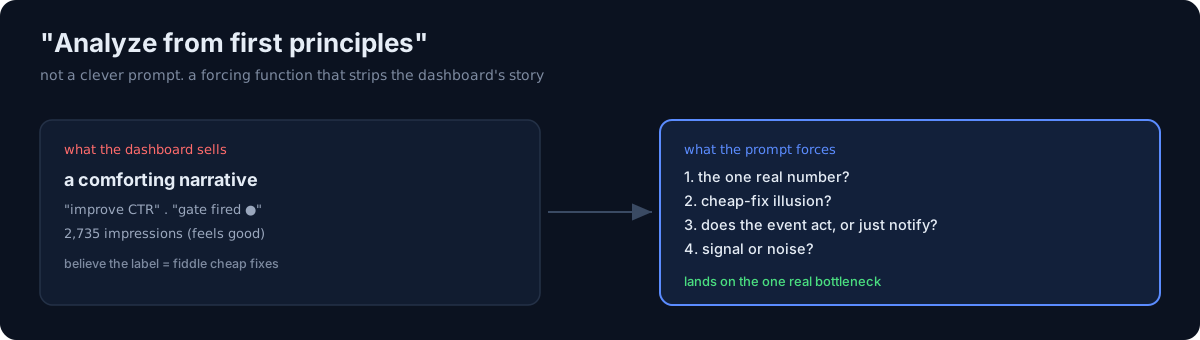
There's one line I reflexively add whenever I look at a dashboard: "analyze from first principles." Twice this week alone it stripped away something I was fooling myself about.
A dashboard sells a narrative, not numbers
Dashboards sell you a feeling through labels: "improve rank," "improve CTR," "gate fired ●" — all reassuring signals that things are about to get better. Believe the label and you spend your time fiddling with cheap fixes.
The four questions the prompt forces
- What's the one number that actually matters? (the rest is vanity or derived)
- Is this label pretending there's a cheap fix?
- Does this event actually do something, or just notify?
- Is this score signal or noise?
Case 1 — the traffic dashboard
48 sites, 2,735 impressions. A number that feels good. Apply first principles: the real number is 8 clicks. Four of the five labels were false hope, and the only lever was domain authority. Full autopsy in a portfolio traffic autopsy.
Case 2 — the self-improvement gate
An automation-fleet dashboard was showing "gate fired ●." A number that feels good. Two questions split it apart.
- (3) Does firing actually do anything? Following the code, it wasn't just an observer notification — it was real wiring that reorders the next batch of content from performance data. So far, real.
- (4) Is that score signal or noise? The firing condition was merely "does data exist," so it was reordering apps off of double-digit view counts. Overfitting noise. Fixed it with a single minimum-sample threshold.
Without those two questions I'd have moved on with "gate's on, great."
Why it works — not cleverness, coercion
This isn't a clever prompt. It's a forcing function. Even with domain knowledge, once you're steeped in the dashboard's narrative you drift toward "let's raise CTR" and "gate's on, nice." The four questions cut that drift and drag you back to the one real bottleneck every time. Zero cost, repeatable — the cheapest version of the habit of treating reusable prompts as tools.
The honest part: the surprise wasn't the prompt's cleverness — it was realizing I don't reliably ask those questions on my own. One line asks them for me, every time.