One commit, two kinds of files
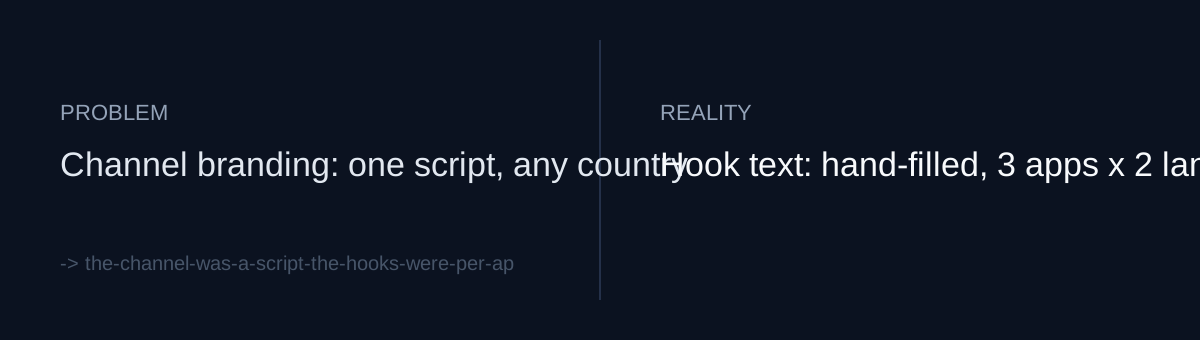
I wrote a script to set up several app-download channels. It handles OAuth, then applies the branding in one pass: description, keywords, country, and a banner per language. That is setup_download_channels.py, 123 lines. However many channels I open, this one file covers it.
The same commit added two more files: apps_hook_en.json and apps_hook_ja.json. They hold the hook lines and cut captions that get overlaid on the video, translated into English and Japanese. Thirty-one lines each. But those 31 lines cover three apps. Three representative ones, and no more.
That is where I paused. The channel side takes country and language as parameters and grows as far as I like. The content side needs a human-written entry per app, per language, before the renderer has a sentence to put on screen. In your own pipeline, how far down does the feature labeled "per-country support" actually reach?
The shell is a script, the filling is a file
Channel branding is write-once work. A description, some keywords, a country code, a banner image. Adding a language adds one banner and a handful of strings. So it became a script, and I still think that was the right call.
Hooks are different. Each app has its own opening scene and its own line meant to hold attention, and someone who knows the app has to choose it. The text seed_render overlays only exists once a cell in the apps-by-languages grid is filled. This commit filled three apps by two languages.
What would you do? Call it "multi-language channels launched" because the setup ran, or call it a channel where only three apps have translated hooks?
What I actually did
Nothing that deserves the word solution. I accepted the grid. Channel setup stays in the script. Hook translations live in per-language JSON files, starting with the three representative apps. Any app without an entry gives the renderer nothing to overlay. The whole point of this commit is that the data file exposes that state instead of code hiding it.
There was no cheap fix. A script could have filled every app in one go. This commit did not take that path. It took hand-written entries per app. So the bottleneck is not the 123 lines of code. It is the number of cells still empty, apps times languages, waiting to be filled by hand.
Self-check
- Does your "per-country support" stop at the channel or settings layer, or does it reach the actual content data?
- Can you state, as a number, how many cells in your apps-by-languages grid are filled right now?
- Do you know what the renderer does for an app with no translation entry: blank overlay, fallback to the source language, or failure?
The honest part
I do not know whether the translated hooks work on English or Japanese viewers. There is no response data yet from videos published through these channels. I have not decided when the remaining apps get their entries. This commit built the channel shell and the first six cells of content, and I did not even count how many cells the full grid has.