Paper-only experiments — none of these trade real money. Figures are generalized; equity charts come from each bot's own report output, never fabricated. Alerts are intentionally off for these (a failed send is expected, not a bug).
A quick tour of the paper bots I keep running, and the one finding that stuck.
The bots
- Swing bots — several variants running swing strategies on paper, each with its own dashboard.
- A TQQQ infinite-buy experiment — the well-known accumulation approach, running one cycle on paper for observation, not converted to a live account.
- A trend bot — a timing-based approach on US equities.
Each reports to its own dashboard; none of them page me, because paper experiments don't earn an interrupt.
The finding that stuck
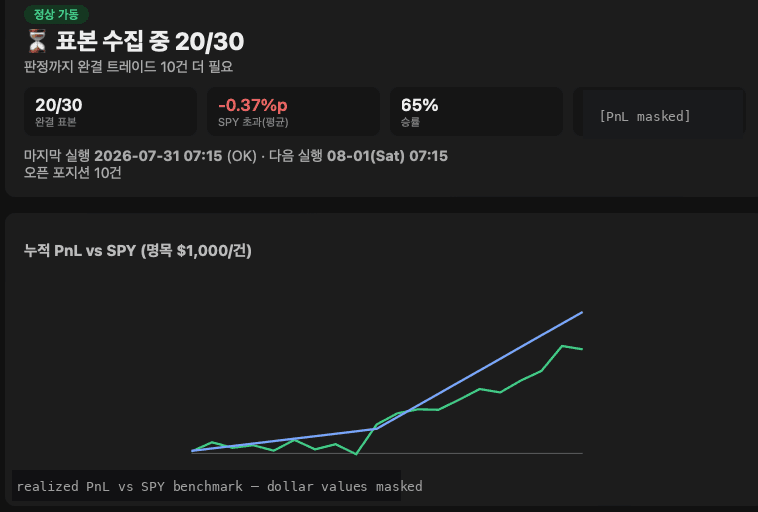
The trend bot's most useful result was deflating. Its timing logic — the clever part — didn't beat the benchmark on a raw basis. What did beat it was a static, one-time leverage (a modest multiple, held): plain leverage, not alpha. That's an important distinction to be honest about: beating the index with leverage is not the same as having an edge. The timing structure I was proud of was the part that underperformed; the boring constant multiplier was what looked good, and only because it's leverage.
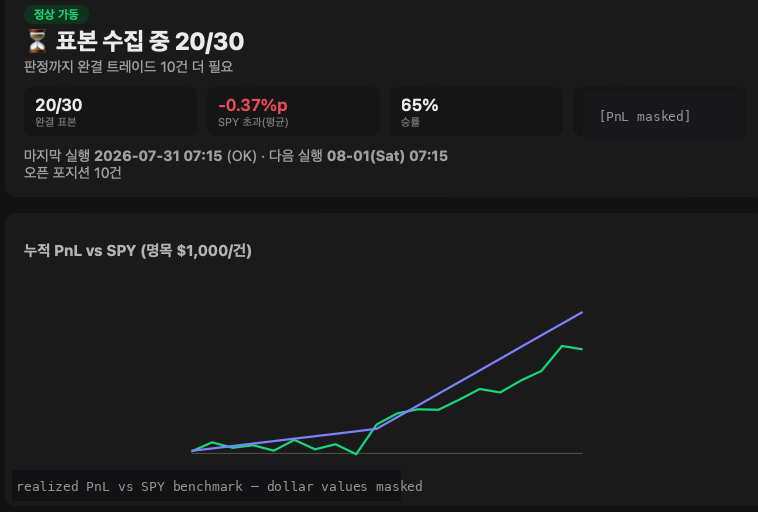 Source: the trend bot's dashboard. Dollar values masked; the SPY-relative shape (benchmark on top), win-rate, and sample count are shown — the timing logic trails plain SPY. Paper only.
The honest part
A portfolio of paper bots is easy to romanticize into "my trading system." It isn't one — it's a set of experiments, most of which will fail their gates, and the useful output is the findings, not the PnL. The trend bot taught me more by underperforming its own gimmick than it would have by quietly "working": if a static leverage beats your timing logic, your timing logic isn't the edge. Keep the bots on paper, keep the alerts off, and let the gates — not the hope — decide what ever goes live.