Can you say, with an exact number, how many customers walked into your online store today?
I couldn't. So I counted. The answer became the conclusion of this post — and the number that invalidated three weeks of work.
Started at zero inventory, then ran a first-principles cleanup
On 2026-08-08 I started listing products on a Korean marketplace store with zero inventory and zero ad spend — a dropship structure where I just relist supplier products. Listings piled up fast, reaching 172 within days. Listing itself was easy. What I hadn't separately checked was the quality of what I'd listed.
Three days later I ran a full audit. Of the 172 listings, 152 (88%) had zero reviews even at the supplier level. My selection filter wasn't screening for "products people want" — it was only checking "passes the category whitelist." 21 clusters of 60 products were cannibalizing each other with the same photos and keywords, and detail pages were leaking internal operating notes straight to customers — phrases like "for initial validation" and "risk of stockout cancellation." Median profit per order was ₩3,510, but the cost of a single return (return shipping + exchange shipping) exceeded that — meaning one return could erase the profit from one to three orders.
So I cleaned it up.
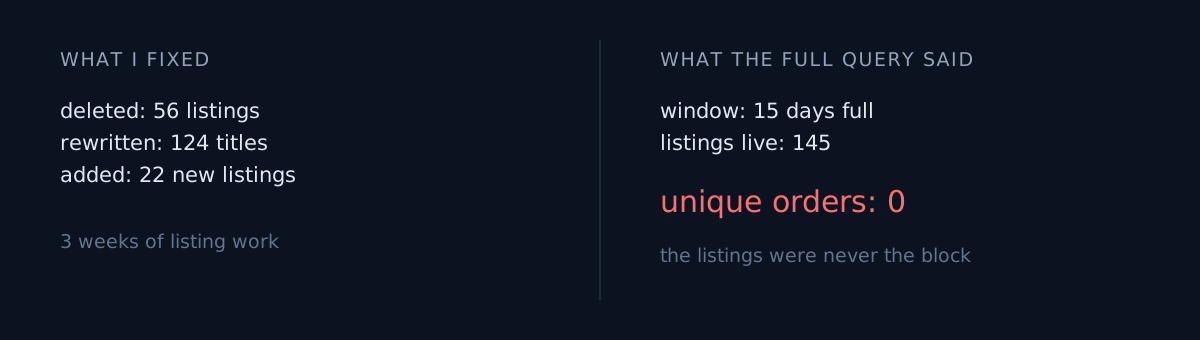
Backup 180 -> Deleted 56 (39 duplicates + 17 low-margin)
           -> Rewrote 124 (removed operating notes, cleaned titles, restocked to 20, SEO meta)
           -> Added 22 new (supplier reviews >= 10 only)
I verified by reading everything back: zero leftover operating notes, zero under-stocked listings. This, I thought, counted as reaching a "sellable state."
What would you fix next?
Once cleanup was done, the obvious next question surfaced: polish the titles further? Fill in more tags? Rearrange categories?
That's exactly what I thought too. I picked three titles to rewrite and preregistered an experiment to measure the change in visibility. But on decision day, something was off. All 145 listings had a registration date after my comparison baseline. There had been no listings at all during the "before" window. The rate of change was zero divided by zero — literally uncomputable. (I wrote up that no-verdict incident separately.)
That failure gave me a hint: I kept fixing the inside of the shop. So I changed the question — not whether the title was good, but whether anyone walked past this shop at all.
I queried every single order across the full 15 days
I sliced the Commerce API's last-changed-statuses endpoint into 24-hour windows and swept the entire period from launch (08-08, 00:00) to today (08-23, 09:42), with no gaps.
Window: 2026-08-08 00:00 - 2026-08-23 09:42 (15 days)
Listings: 145 (post-cleanup: 56 deleted, 124 rewritten, 22 added)
Unique productOrderIds caught by status-change events: 0
Zero. This isn't a case of deferring judgment because the sample is small. I looked at the entire possible window, and it's zero.
I overlaid the visit data too: zero total store visits in the pre-rewrite window (08-01–07), 15 visits spread across 12 listings in the following 7 days (08-15–21). Getting zero orders out of 15 visits isn't a conversion-rate problem. It means almost nobody was walking past to begin with.
This doesn't mean three weeks of work were wasted
There's an easy misread here: "so was the cleanup pointless?" No. Removing the return-policy leaks, cutting low-margin listings, untangling catalog self-cannibalization — these are all variables that would matter to conversion once a customer actually shows up. But none of that shop maintenance can move the outcome before someone shows up. For three weeks I was scaling up one term in an equation whose product was already zero.
Revenue = impressions x click-through rate x conversion rate x profit per orderWhen impressions are near zero, no matter how much you grow the other three terms, the product stays zero.
A three-line self-check
If you're running an online channel right now, check these three first.
- Have you ever queried your full order history end to end? Not a dashboard summary — sweep the API from launch day to today with no gaps.
- Do visits and impressions move in the same direction as your product improvements, or independently? If you fix the product and visits stay flat, the product was never the thing that was broken.
- Which term in the equation is currently near zero? Fix that one first, or everything else is waste.
The honest part
This channel closes here — FAIL. Not a product or detail-page problem: the conclusion is that there is no distribution channel at all, which is the same answer a full asset audit reached two months earlier. This is the third time I've confirmed the same conclusion on a different asset.
Maintenance automation (a daily early-morning check, zero real cost) keeps running. What I'm killing is the decision to invest further in this channel, not the already-built, no-cost infrastructure. Next time I feel the urge to add listings or polish a detail page, I'm coming back to this post's numbers first — anything multiplied by zero is zero.
Whatever project you're holding onto right now — have you actually counted whether there's real traffic behind it? It took me three weeks to count mine.