The most valuable thing a research agent ever told me was that the thing I wanted to be true wasn't verifiable.
What the swarm is
It's a multi-agent research pipeline with four phases:
- Fan-out — decompose the question into search angles, one agent per angle.
- Fetch — dedupe URLs, pull the top sources, extract falsifiable claims.
- Adversarial verify — for each claim, spawn independent skeptics whose job is to refute it. A claim needs a majority of refutations to be killed.
- Synthesize — merge survivors, rank by confidence, cite sources.
The key move is phase 3. Most "AI research" summarizes whatever it found and hands it back agreeing with itself. This does the opposite: every claim has to survive agents actively trying to knock it down.
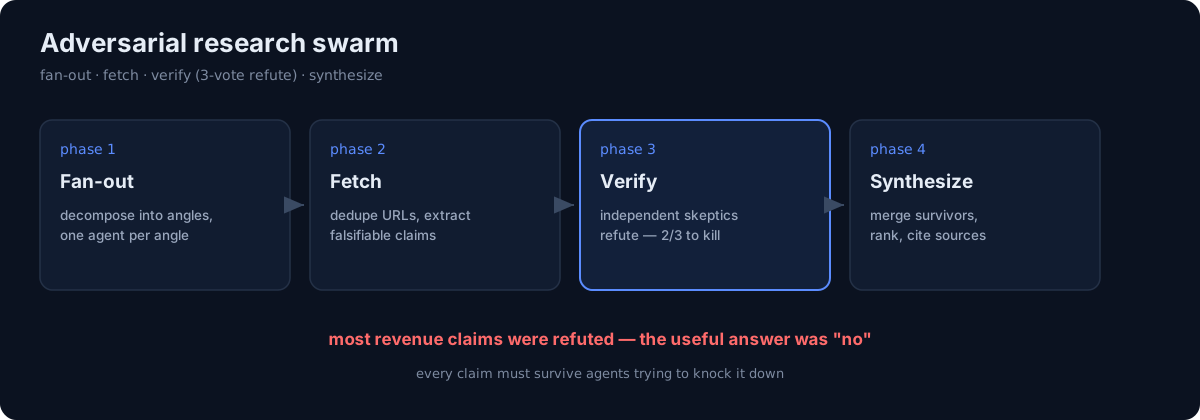 One run: 100+ agents across search, fetch, verify, and synthesize.
The question I pointed it at
Before building anything, I wanted the honest state of "can you make money auto-posting content to YouTube?" I ran the swarm twice, aimed specifically at first-person creator reviews and verifiable revenue numbers.
Both times, the adversarial pass killed almost every revenue claim. "This channel made $X/month and got demonetized without warning" — refuted, because it couldn't be independently corroborated. What survived was policy fact and enforcement cases, not anyone's dashboard.
Why a negative result is the win
That "no" saved me from building on a fantasy. The verified takeaways were sober: platform authenticity rules target template-farmed, low-transformation output; reused/compiled clips are ineligible; the durable play is original value on top of automation, not automation alone. None of it was the get-rich story. All of it was actionable.
A swarm that only confirms is a very expensive way to fool yourself faster. A swarm that argues against you is a cheap way to avoid a bad month.
What I'd tell you to steal
- Put the skeptic in the loop. Verification that just re-reads the source isn't verification. Give each verifier a distinct lens (does it reproduce? is the source primary? is there a conflict of interest?) and require a majority to kill.
- Prize the negative results. If your research process never tells you "no," it isn't researching — it's rationalizing.
- Cite or drop. Anything that survives should carry its sources so future-you can re-check when the facts move.
The build that came after this — the pipeline, the honest reach numbers — exists because the swarm refused to let me pretend the easy version was real.